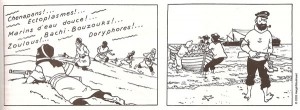
He's fully satisfied with these.

Hergé: …I am quite happy with the panel showing the panic in the ranks of the pillagers [above left]. It’s one of the two panels that satisfy me fully: in a single panel, a series of movements, broken down and distributed among several characters. It could have been the same individual, lying down first, then getting up slowly, hesitating and finally running away. It’s basically, if you will, a shortcut through space and time.

Sadoul: What is the other drawing you’re happy with?

Hergé: It’s in Red Rackham’s Treasure [above right]. Everything is condensed, too, but in a different way. By looking at the drawing itself, which shows the captain walking barefoot on the beach while his companions are pushing the dinghy ashore, the spectator/reader mentally reconstructs what happened before: the “Sirius” has dropped anchor, a dinghy was lowered in the water, Tintin and his companions boarded; they rowed and finally reached the island where the captain just set foot. All this, which preceded the action depicted in the drawing, is expressed within that same panel. This drawing is based on a principle different from Crab’s – which I just described – where the effect is the result of both the simultaneity and the succession of movement. In this one, on the contrary, this is an unconscious reconstruction, by the reader, of movements which happened prior to the drawing. It’s like a self-generated mental flashback. Although the reader doesn’t realize it, he/she is unconsciously subjected to this entire analysis.

Sadoul, Numa. “The Hergé Interview.” The Comics Journal 250 (Feb 2003): 201.

8 Responses to “Two Panels by Herge”

  1. J. Overby says:

    good post. Relates, I think, to Jason Miles’s post on comicscomics about the Shadow and Kyle Baker. To me, Hergé, is much more subtle and artful. His explanations are so lucid and articulate. I’m not really a fan of Tintin, but the process behind his decisions is fascinating, and he is a beautiful draftsman.

  2. DerikB says:

    With Tintin, Herge does some much subtly, from a formal perspective, that it’s almost invisible. The way he handles the turn of the page, or the movement of characters across the page. It all reads so seamlessly that you don’t think of it at all.

  3. J. Overby says:

    I’ve talked quite a bit with Blaise about wanting to make comics that function as seamlessly as this, where the form is virtually invisible and nothing gets in the way of the narrative, but I just don’t Think I have it in me. I get caught up in tangents and weird ideas I have in the moment, and I feel weird about not revealing “myself” as the storyteller. I was listening to this Annie Proux audiobook today, and I just hated it – there was nothing urgent about it, just a re-hash of Jim Thompson and Elmore Leonard and stylistic “quirks” from creative writing seminars. I think I feel the same way about Tintin, and that’s, maybe, why I’m not so into it. I don’t hate Tintin, but it’s not very exciting to me. It’s crafted so well that it’s almost too seamless for me. I can’t make comics like that. But it may just be that I was too lazy to ever learn to draw well representationally…

  4. J. Overby says:

    Hmmm… that said, I’m currently reading Denis Johnson’s “The Name of the World” and really liking the flat stylistic tone a lot. Pretty seamlessly well crafted… but the content is a lot different from Hergé’s, too.

  5. DerikB says:

    I totally agree. The best parts, to me, of Tintin of these isolated moments where you can find something interesting going on. I think of it more as a learning experience, and I get more out of Tintin that way than as a story I get real engaged with.

    I’ve never been real desirous of making work that is stylistically invisible or narratively seamless. Probably comes from my early love of 60s metafiction and that ilk (Borges, Calvino, Barth).

  6. J. Overby says:

    oh, yeah – love that stuff, of course, but it’s such a natural mode for me that I feel guilty, I guess.

  7. DerikB says:

    Guilty? Bah. As long as the work is interesting.

  8. J. Overby says:

    Thanks, and ditto!

Leave a Reply


Notify me of followup comments via e-mail. You can also subscribe without commenting.